

Development Windows
FreeBASIC for Windows
Compile BASIC source into Windows executables and libraries with FreeBASIC, a free, open-source command-line compiler with a QuickBASIC compatibility mode.
- Operating system
- Windows (64-bit package)
- Architecture
- x64
- Download package
- ZIP archive; standalone compiler
Extract the archive to use the compiler. A text editor or IDE is separate. Other 32-bit and combined packages are available from the publisher.
Link checked · Download guidance
What is FreeBASIC?
FreeBASIC turns BASIC source files into executable programs rather than running them in an interpreter. It suits developers writing console tools, graphical applications or libraries, as well as programmers adapting older QuickBASIC code. The Windows distribution includes compiler tools and runtime libraries; this download is the standalone 64-bit ZIP package for version 1.10.1.
The language adds pointers, user-defined types, inline assembly and a C-style preprocessor to its BASIC syntax. Bindings let programs use C libraries and APIs such as SDL, OpenGL and the Windows API. FreeBASIC can produce console or GUI executables and static or dynamic libraries.
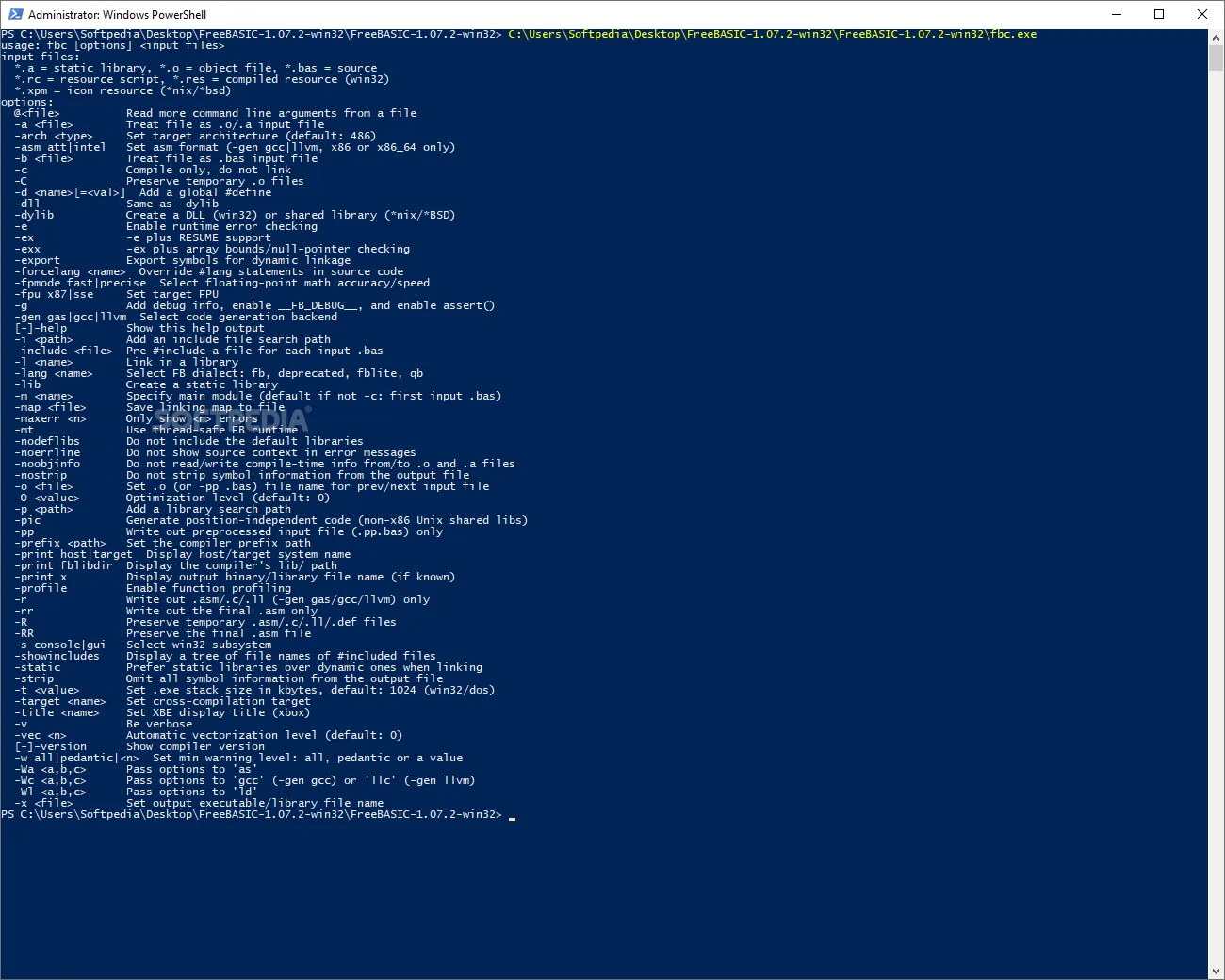
FreeBASIC itself is not a graphical editor or an all-in-one IDE. Write source in a separate text editor or compatible IDE, then invoke the compiler from that environment or the command line. Its QB language mode improves QuickBASIC compatibility, but switching substantial older programs to the default FreeBASIC dialect usually requires changes. The screenshot illustrates the older 1.07.2 win32 compiler interface in PowerShell, not the selected 1.10.1 x64 release.
What it offers
- Compile .bas source files into Windows executable programs.
- Create console applications, GUI applications, static libraries and DLLs.
- Use a QB language mode for QuickBASIC-oriented source code.
- Work with C library bindings, including SDL, OpenGL and the Windows API.
- Use pointers, user-defined types, inline assembly and preprocessor macros.
Good to know
- The compiler does not include a graphical source editor or IDE; use a separate editor or command-line workflow.
- Most substantial QuickBASIC programs require changes to compile in the default FreeBASIC language mode.
- C++ library support is partial, unlike full support for C libraries.
Product images
Sources
References used for this listing. Retrieval dates do not indicate hands-on testing.
More in development
View category ↗

010 Editor 17.0
Inspect and edit binary files on Mac with 010 Editor, a paid text and hex editor with Binary Templates, file comparison and a 30-day trial.
010 Editor 17.0
Inspect and edit binary files with 010 Editor for Windows, a text and hex editor with Binary Templates, file comparison and scripting. Includes a 30-day trial.
10x Editor
Edit and navigate C++ projects on Windows with a built-in parser, workspace search and Visual Studio project support. A paid license is required after the 30-day trial.