
Utilities Windows
Kalker
Evaluate math-like expressions, define reusable functions and work with complex numbers using Kalker, an open-source scientific calculator for Windows.
- Operating system
- Windows; minimum version not specified in the cited publisher documentation
- Architecture
- 64-bit; processor instruction set not specified in the cited binary listing
- Download package
- MSI installer
Publisher lists 64-bit binaries for Windows. Installer execution and compatibility were not tested.
Link checked · Download guidance
What is Kalker?
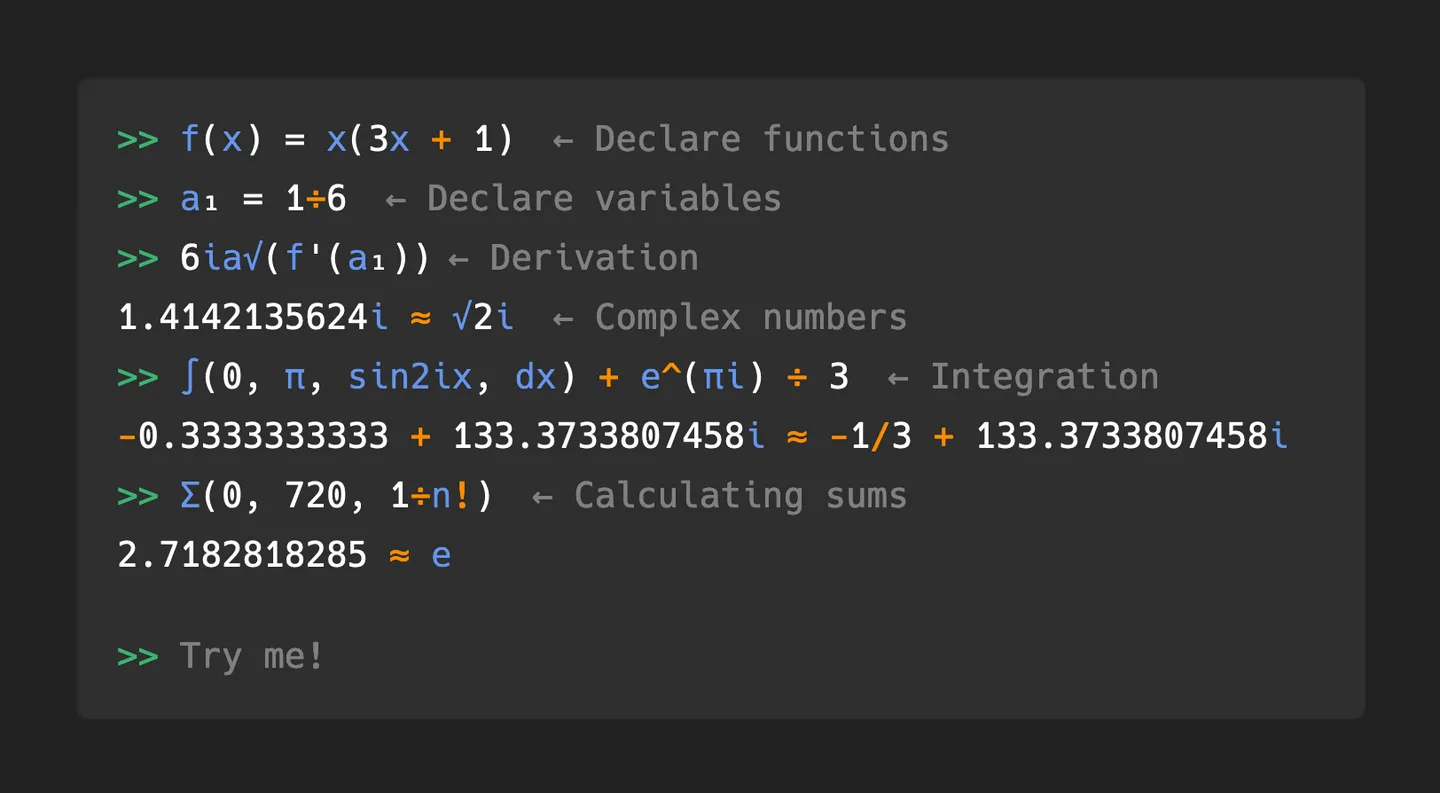
Kalker is an expression-based scientific calculator for calculations that need more than a sequence of button presses. Define variables and functions, reuse them in later expressions, and work with complex numbers, vectors and matrices. Its math-like syntax accepts expressions such as 2xy, while syntax highlighting and Tab completion help enter mathematical symbols.
You can load files containing your own function and variable declarations instead of retyping them for each session. Kalker also estimates derivatives, definite integrals and roots. These are numerical results, not guarantees of exact symbolic solutions: higher-order derivatives can be inaccurate, and the root finder is limited to one root.
This entry links to the Windows MSI offered by the publisher. The publisher lists 64-bit binaries but does not specify minimum Windows versions in the cited documentation. The illustration is the publisher’s shared calculator interface preview, not a verified capture of this Windows installer.
What it offers
- Define variables and reusable functions using math-like expression syntax.
- Calculate with complex numbers, vectors and matrices.
- Estimate derivatives and definite integrals; find a root using Newton’s method.
- Use syntax highlighting and Tab completion for mathematical symbols.
- Load files containing predefined functions and variables, including a default.kalker file loaded at startup.
Good to know
- Derivatives and integrals are numerical estimates; the publisher warns that higher-order derivatives can be inaccurate.
- Newton’s-method root finding is an estimate limited to one root.
Product images
Sources
References used for this listing. Retrieval dates do not indicate hands-on testing.
More in utilities
View category ↗
1.1.1.1 with WARP 2026.8.2115.0
Encrypt traffic from your Mac to Cloudflare’s network with WARP, or use DNS-only mode for encrypted DNS queries to the 1.1.1.1 resolver.
1.1.1.1 with WARP 2026.8.2115.0
Encrypt traffic between your Windows PC and Cloudflare, or use encrypted DNS only, with the free 1.1.1.1 with WARP app.


3uTools 9.12.005
Manage iPhone and iPad photos, music, apps and backups from Windows with 3uTools, a free utility that also includes device checks and firmware flashing tools.